International - Ekhbary News Agency
Strait of Hormuz Under Strain: A Strategic Crisis with Global Repercussions
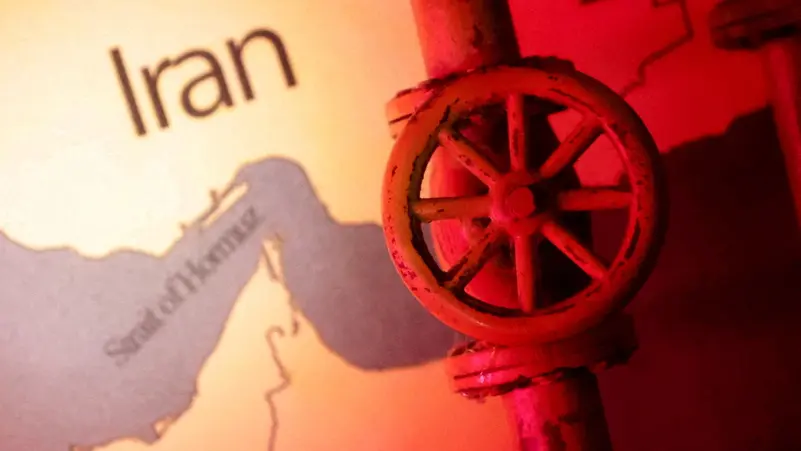
The Strait of Hormuz, a strategic waterway connecting the Persian Gulf to the Gulf of Oman, is currently the scene of escalating tensions that threaten to severely disrupt global energy supplies. Recent Iranian actions in this crucial area have not only rekindled fears of an open conflict but have also highlighted the vulnerabilities of the international oil and gas market. Tehran's objective appears clear: to exert maximum economic pressure on Western powers, particularly the United States, by driving up oil and gas prices.
The situation is illustrated by growing consumer anxiety. A press cartoon published by the Belgian newspaper Le Soir depicts a pro-Trump American couple questioning rising prices and ironically suggesting that the president "could widen the Strait of Hormuz." This caricature, noted by Le Monde, underscores popular frustration with the direct economic impact of this distant crisis. The Strait, only 54 kilometers wide at its narrowest point and featuring navigation lanes of 3.7 kilometers each for oil tankers, is a choke point through which between 20% and 25% of the world's produced oil and liquefied natural gas transit. By increasing attacks on vessels, Iran seeks to paralyze this vital artery, making passage so risky that insurance and transport costs explode, inevitably leading to higher prices at the pump.
Read Also
- NASA's Kennedy Space Center Infrastructure Unprepared for Super Heavy Rocket Era
- GM Installs Robots at EV Plant Amidst Layoffs, Sparking Union Outcry
- Free Streaming Trials in 2026: A Comprehensive Guide to Available Options
- How to Stream Norway vs. Senegal World Cup 2026 Match Free Online
- Prime Day 2026 Headphone Deals: Sony XM6 and AirPods Max 2 Lead Early Sales
Naval confrontation has already begun, according to Rome's La Repubblica. After the United States announced it had "neutralized" sixteen Iranian mine-laying vessels, the Iranian Revolutionary Guard, known as the Pasdaran, retaliated by attacking three ships. Their threats are unequivocal: "Any vessel or oil cargo belonging to Israel, the United States, and their allies will be considered a legitimate target. Not a single liter of oil will pass through the Strait. Prepare to pay $200 a barrel." These statements demonstrate a firm willingness to defy the international community and overturn the global economic order.
Experts and maritime transport actors anticipate a prolonged crisis. The Wall Street Journal reports that carriers are preparing for a "prolonged closure" of the waterway. A Greek executive from a liquefied natural gas transport company emphasizes that restoring traffic will take time, even after hostilities cease. "It is not enough for hostilities to stop; shipowners must also see a significant reduction in risks for people on board and for vessels," he explains, citing the example of the Red Sea where, six months after Houthi attacks ceased, traffic has still not returned to normal. Trust and a sense of security are paramount, and they are far from being restored in the Strait of Hormuz.
The question of securing the Strait is at the heart of international concerns. London's The Times describes the Strait of Hormuz as "a living hell" for navigation and warns that securing it will be extremely difficult. Iran has been preparing for decades, building an arsenal of over 5,000 mines and a thousand small boats capable of deploying them rapidly. For many observers, the only lasting solution, in the absence of regime change in Tehran, lies in a ground military presence. Neutralizing the threats from the Revolutionary Guard – coastal missile batteries, maritime mining operations, launch sites – requires sustained land control. While naval technology can manage crises at sea, the long-term security of critical maritime passages depends on some form of land control, even without large-scale conventional ground deployment.
Related News
- Malawi: Children Demand Child-Sensitive 2025-2026 Budgeting
- Hundreds Of Passengers Have Said They Were Sexually Assaulted On Cruise Ships. Their Stories Highlight Years Of Lax Security, Critics Say.
- Chaplin: Starting Pepper Seedlings in Late January is Possible with Grow Lights
- Ministry of Education: Kindergarten Operations Can Be Adapted to Parents' Work Schedules
- 13 Best Flower Delivery Services To Show Your Love From Miles Away
Meanwhile, Russia positions itself as a cynical and opportunistic observer. As Libération points out, the surge in oil and gas prices is entirely to Moscow's advantage. This new crisis, which mobilizes considerable resources and monopolizes media attention, also diverts Western, particularly American, focus from the conflict in Ukraine. President Vladimir Putin, despite recently losing major allies like Bashar al-Assad, Nicolas Maduro, and Ali Khamenei, is on the verge of becoming a central player in the global energy market once again. The paralysis of the Strait of Hormuz suddenly makes Russian energy resources highly coveted, including by Europeans who had just decided to end their imports of Russian gas. In this global chaos, Putin appears as one of the few leaders to remain impassive, with oil and gas revenues flowing in, and with them, the hope of a partial reintegration into the international arena.